
Why is customized learning so important?
Every teacher or youth worker deal with students who have extra needs. If we as a society is going to prevent alienation and that as many students as possible complete their education and becomes a resource in society, we must make school manageable. The school with its requirements and expectations is not suitable for everyone and may lead to increase dropouts and unemployment. In order to help these students, to get knowledge and get something out of their schooling, we must start by making school manageable and an arena for coping and succeeding.

This is what you will learn more about during this training:
- Student mapping
- Student participation
- Varied teaching methods
- Student Inclusion
- Evaluation/testing/assessment
… and after completing the training, you are expected to be able to
- Map and identify individual student needs and find good and varied teachings methods while still following the curriculum.
- Be able to address the challenges and take concrete measures as part of ongoing teaching to increase students’ understanding and participation in teaching
- Be able to lead a classroom where all students, regardless of their backgrounds, needs and diversity, feel a sense of belonging.
- Be able to evaluate the effect of their own measures.
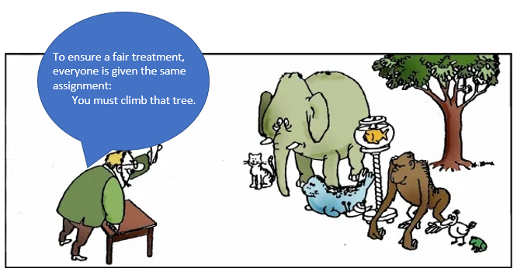
Personalized learning, individualized learning and personal learning environment all refer to efforts to tailor education to meet the different needs of student. You adapt learning to each students level and ensure all students get the best opportunity to succeed.
Individualized instruction means that you as a teacher gives the student instructions based on their level of understanding and coping.
Tailoring education means that you make sure that the students are learning at their level, and that you don’t expect more of them, than they can handle.
Topic 1: Customized learning (theoretical)
Topic 2: Transfer of knowledge
Topic 3: Methods and tools (activities)
Topic 4: Final assessment (interactive task)
Customized learning applies to all students, apprentices, candidates, and adults. Customizing the training means adapting with varied forms of assessment, learning resources, learning arenas, and learning activities so that everyone gets the best possible benefit from the training.
Customized learning is …
- Personlized learning
- Individualized instruction
- Tailoring education to meet the different needs of students
Teachers should help cultivate curiosity and a desire to learn, and to motivate the youth for lifelong learning.
- Identity:
- anchoring their identity will enable them to adapt better in the classroom and feel safer
- Cooperation:
- between student/student, student/teacher, class, and business industry.
- Makes it easier to include students with extra needs and challenges. Start slow, but reach a goal.
- Creativity:
- give assignments that develop creativity and that demand more than facts from the students. This will enable students to think outside the box and use the skills they have that otherwise are not academic.
- This is expected in the «real world».
- Creates a sense of mastery because it’s at the student’s own tempo.
- Action:
- The industry emphasizes that students should be trained in taking initiative and showing action.
- Experience in public presentation promotes self-confidence and creates awareness of the students’ stronger qualities.
- Start small (one –to-one), set a goal on how much the student is can participate.
- Don’t make the assignment impossible for the individual.
True or false:
- Customizing the training means adapting with varied forms of assessment, learning resources, learning arenas, and learning activities so that everyone gets the best possible benefit from the training
- Customize learning can not be used on all students
- Every student learns best by learning the same way as everybody else
Customized learning is: Personalized learning, individualized instructions, and tailoring education to meet the different needs of students
All students have different starting point, which teachers must be aware of.
This could be:
- Different mental or physical challenges
- Family or home challenges
- Learning disabilities
- Foreign diversity
- Other situations that get in the way of learning
These factors can play a role in how receptive students are for learning and can make the students not receptive for learning at all in periods.
Teachers must use time and get to know each student, to make the best customized and personalized learning.
- Student mapping
- The school must give all students opportunities for learning and development regardless of their prerequisites.
- The teacher must map the student’s life situation, learning abilities and preferences to facilitate a training that accommodates each individual student, so that the students get the best possible benefit from the training.
Methods for student mapping:
Mind mapping
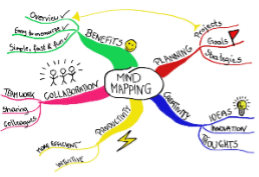
Where are your strengths? (Are you a social person? Do you have a lot of ideas? Do you like to have a plan or are you impulsive? Do you like practical work? Do you prefer things over humans? Are you creative?)
Where are your possibilities?
How do you learn best? (In teams with others? On your own? A combination?)
What’s your interests? Skills?
My roadmap
Create a roadmap of your life including the things, both positive and negative, that make you who you are today. You can make the map however they wish, using colors, clippings, drawings and/or words. Make them tell you about their roadmap afterword (one to one).
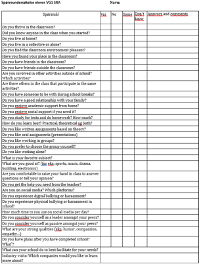
Classroom survey
Ask questions about how they learn best, if they have any friends in class, their goals for school, etc. Everyone will answer, and in that way this survey will be harmless, but it will give you answers about each student.
- Student participation
The teachers should involve students in assessments and choices based on what is appropriate for their age, development, and level of maturity.
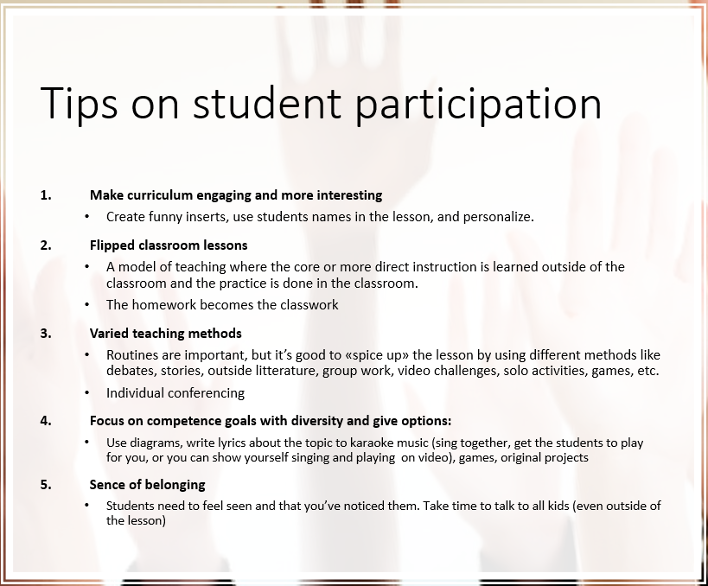
To make students participate, these tasks can be used to make them feel comfortable and safe with you and their fellow peers (Classroom integration):
Methods for student participations:
“True or false”
This is an assignment to getting to know each other. Everyone must tell two things about themselves that are true and one thing that is false. Fokus on topics that give an increased cultural understanding of who you are.
The group must guess which statements are false afterwards by voting. The group can ask questions to the teller about their topics of choice, both true stories and false.
“The sun shines on me”
This assignment is about trust, connection, and empathy.
The group sits in a circle. There is one less chair than people. One stands in the middle and says «the sun shines on me and everyone who…» Everyone who relates to the statement rises and finds a new place to sit. The person who does not find a chair is in the middle. Start with simple questions, and after some tries, move on to more personal topics like mental health, bullying
“Factory”
The class are workers in a factory, and they must show how effective they can be to increase production.
Everyone is in a circle. One student is the department manager and starts production by throwing 1 yarn to another student. That student throws to another (and so on) until all students has had the yarn in their hands. The students must remember who they send it to. Several yarns will be added to the production and the production will be based on time.
Find a solution together that will make the production most effective.
- Varied teaching methods
- Together with the students, teacher will find learning activities, learning resources and arenas that are most appropriate for achieving the goals in the curriculum
- Learning can take place in many places, for example in the classroom, out in the schoolyard, in the woods, on a trip, library, workshop or in the local community
- Physical activity and aesthetic forms of expression can be part of varied method use in all subjects and at all stages.
Diverse sites and digital tools to use in classrooms:
- Kahoot: https://kahoot.com/
- Teams: https://www.microsoft.com/nb-no/microsoft-teams/group-chat-software?ms.url=teamscom&rtc=1
- Zoom: https://us02web.zoom.us/webinar/whatis
- Minecraft: https://education.minecraft.net/en-us/homepage
- Educreations: https://www.educreations.com/examples/
- Flipped classroom method: https://omerad.msu.edu/teaching/teaching-skills-strategies/27-teaching/162-what-why-and-how-to-implement-a-flipped-classroom-model
- Social media: create adds, marketing techniques, strategies

- Student inclusion
- Inclusion in the school means that all students must belong to a class and take part in the school community. It is important to recognize and value the diversity of students, and to view diversity as an enrichment and resource
- The training should contribute to all students being able to actively participate in the class activities, listen to input from fellow students and acknowledge each other for what each one contributes.
- Professional and social learning affect each other. A basic prerequisite for a good learning environment is that all students feel a sense of belonging to a professional and social class community.
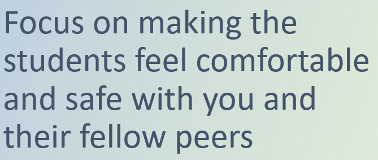
Methods for student inclusion:
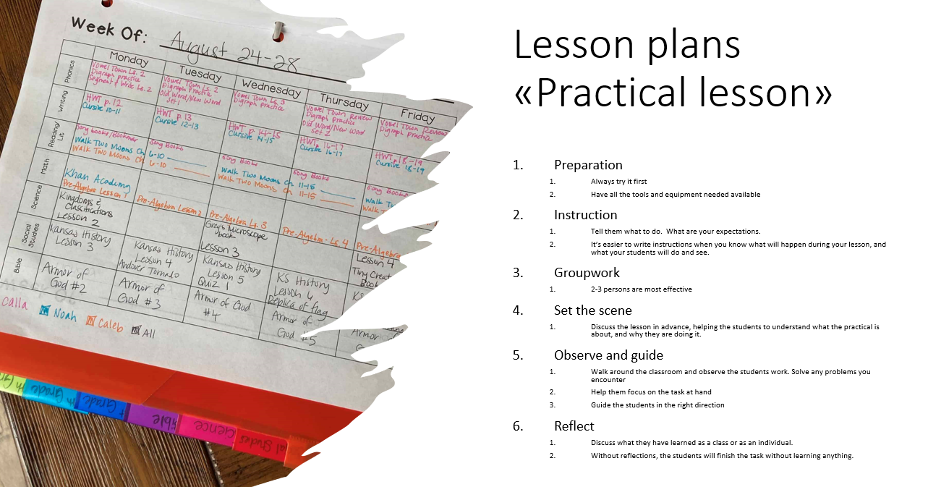
Lesson plans
- Evaluation of students
- Good assessment, where the expectations are clear and the student participates and is heard during the learning process, is a key to customizing the teaching.
- Mid-term assessment should help to promote students’ learning and that they develop competence in line with the curriculum.
- Knowledge and motivation is important in order to be able to give constructive assessments, plan and adjust the training so that it is adapted to the students.
- Based on the curriculum and knowledge of the student group, the teacher can adapt academic content, tasks and learning strategies that can promote learning.
- Feedback is very important for learning. In order for feedback to help promote learning, it should give students and apprentices an overview of where they are in its learning, where they are going, and what they should do to advance in learning.
Put in order and choose what methods/tools will suit your group of students?
- Mind mapping
- My roadmap
- Classroom survey
- “True or false”
- “The sun shines on me”
- “Factory”
- Varied teaching methods
- Student inclusion
- Lesson plan
- Evaluation of students
The participants read the situations and give their answers in Padlet and/or in groups.
CASE
You have a class of 20 students. It is the last two periods of the school day, and you have the class in the subject history.
Three of the students are foreigners, and quite weak in language, one student has a slight case of autism and struggles with social skills, one is in foster care and is dealing with home issues, two of the students are at risk of failing. Four are very good theoretically and contribute well both physically, professionally, and socially. The rest are average students with different challenges, but function well in the classroom.
Create a lesson plan using different forms of practical and theoretical tools.
