
Motivation challenges:
The main reasons for the unemployment of unmotivated young unemployed people who are not ready for the labor market are low level of education and abilities, lack of motivation and lack of self-confidence. These reasons are closely related to each other and influence a person’s helplessness and prior reluctance to change the current situation, to achieve higher goals. In order to help these individuals integrate into society and the labor market, it is important to strengthen, first of all, the motivation and self-confidence of these individuals, to encourage them to take personal responsibility for their lives. Motivation starts with a need, a vision, a dream or a desire to achieve something that sometimes seems impossible.
Cognitive skills:
- Understand the training needs of young people with a lack of motivation.
- Basic understanding about teaching methods that improve learners’ motivation skills.
Understand how to adapt, differentiate, and evaluate teaching methods that meet the students’ different social environment and experience.
Soft skills:
- Improve, increase, and expand motivational skills.
- Understand and be able to implement effective group work organization methods and techniques in diverse groups of participants.
To master and be able to use effective motivational methods and techniques of individual and group work.

- Personality – can be described as a unique way of thinking, feeling and acting. A personality is made up of a unique single set of certain traits. In the most general sense, personality is an individual distinctive character, i. y. what separates one person from another.
- Ability – understood as the ability to successfully perform a certain job.
- Interest is an activity that a person enjoys performing or emotions that arouse curiosity, attention to certain things, objects or events.
- Tendency is the inner need of a personality to engage in a particular activity. Inclinations have a strong connection to talents and interests. Good performance is accompanied by good performance.
- Hobbies are all things that a person likes to do.
- Self-assessment is an assessment of an individual’s self, his or her abilities, qualities, and place among other people.
- Intrinsic motivation is a force that promotes human actions and behavior. It is the totality of personality-derived factors that cause, maintain, and control behavior.
- The purpose is the intended and desired result of an action of a human activity or behavior. It combines various motives, purposeful, consistent human actions into a certain system, the operation of which is closer to the intended goal.
- Topic 1. Motivation (theoretical)
- Topic 2. Transfer of knowledge (methodical recommendation)
- Topic 3: Methodology frame (activities)
- Topic 4: Final assessment (interactive task).
- Motivation is an important factor that conditions a person’s activity. It can be described as the promotion of real behavior, actions, activities caused by various motives. Motives performs several functions in human life. First of all, motives drive human behavior and it directs In addition, motives help to feel the meaning of one’s activity, participate in controlling and changing it. Depending on what motives motivate a person to do something, the process of that activity or them the results can be satisfying or, on the contrary, disappointing. Each action is performed by a person motivated by certain motives, the proper performance of the work is also closely related to the customer motivation.
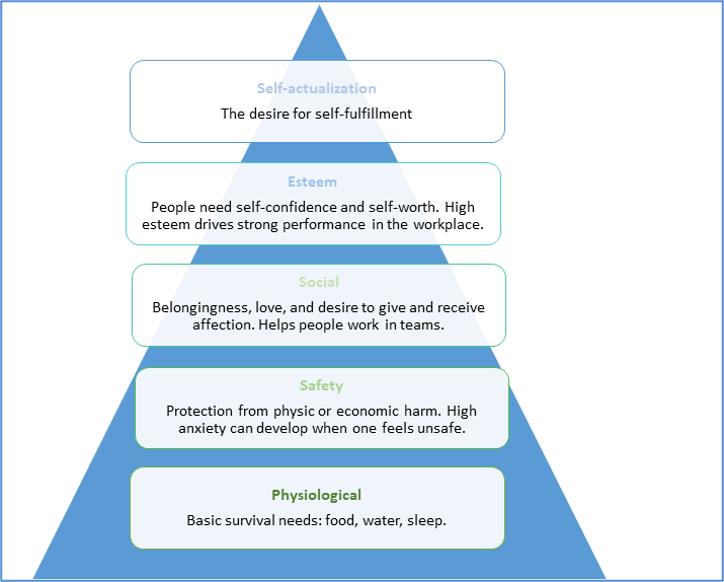
Motives are related to the satisfaction of human needs. The author of the theory of needs, A. Maslow, divided human needs in a hierarchical order into 5 groups:
1 physiological needs (breathing, eating, drinking, sleeping, etc.),
- Security needs (physical, psychological, financial, freedom from fear, stability, order, health),
- Needs of belonging and love (belonging to a family, team, group, communication, friendship, love),
- Needs for evaluation/respect (self-esteem and self-worth, respect and appreciation shown by others),
- Needs for self-actualization/self-expression ( realize their unique capabilities).
Maslow noticed that “when no needs are satisfied, then the organism is controlled by physiological needs, and all other needs can simply cease to exist or be pushed to the background”.
Mark the correct answer:
- Motivation is variable
- Customer involvement is important in the motivation process
Motivation is driven by activity
- Promoting motivation for activities. Self-assessment of starting point, position.
Being motivated means clearly knowing what you want and what you want from life. Sources of motives are: urges; needs; interests; inclinations; attitudes; ideals; beliefs; emotions; the will; intentions. The first step to take is to create your dream, to name what you really want to achieve in life. Then set short-term and long-term goals.
Human motivation for change is like a process made up of different stages, together forming a cycle of motivation. Scientist described a transtheoretical human behavior change model. According to the transtheoretical perspective, when changing problem behavior people undergoes several stages of change. The case manager’s job is not to try to solve the problem immediately, but to help to go through all the stages. This understanding of stages is important in understanding how change occurs.
The consultant does not rush, but helps to grow and go through the following stages:
- Before problematic thinking (not seeing the problem);
- Problem recognition (consideration);
- Taking responsibility for solving the problem (self-determination);
- Change planning and change attempt (actions);
- Maintenance of the change (maintenance);
- Relapse prevention (relapse).
The consultant plays a key role in ensuring the proper involvement of the client, they must think carefully about the methods used to shape interactions and anticipate their effects. It remains particularly important the primary stage of assessment, the boundary where mutual interaction passes into mutual relations, because the client may give up, thinking that the case manager is asking too much of him. Everyone applies the way of support in a specific situation can affect the client differently. Consultant only encourages the client to change, he cannot insist.
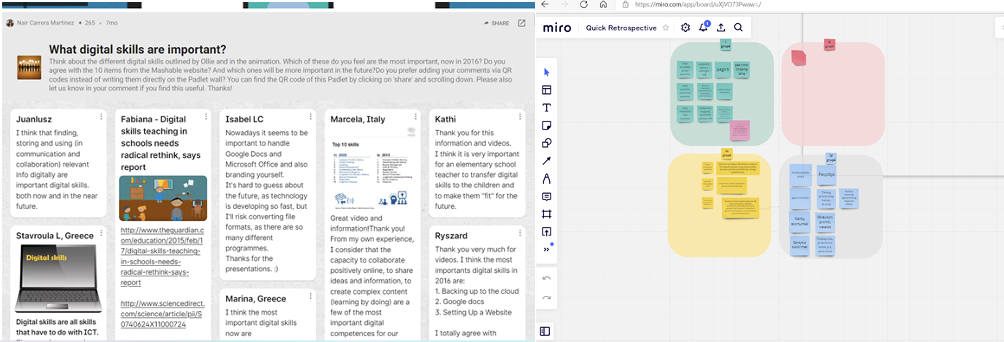
What challenges you have working with groups increasing self-confidence? – please write min 5 points.
Example how could look answers (for.egz.Padlet or Miro):
To maintain motivation helps:
- Self-motivation (self-motivation) is the ability to motivate oneself, find arguments and strength to do something consistently and persistently without other people’s (external) influence.
- Having a vision and visualizing (imagining what I want, what I dream about as concretely as possible).
- Goals. Set goals that give direction to our activities.
- Start. Dare to take up new activities, look for new opportunities.
- Self-knowledge. To find out one’s strengths and areas to be improved, to identify what undermines and what strengthens dreams
- Activity. From thoughts, ideas to action, don’t delay anything
- Optimism. Positive thinking helps overcome obstacles – no one achieves success without making a single mistake.
- Learning new things. It is an ongoing process. Change the personal attitude “I don’t know” to “I haven’t had time to find out yet”. Such an attitude increases self-confidence.
- Success stories. Stories, biographies, etc. of people you know and don’t know to motivate and inspire.
- Like-minded people. People who support you or encourage you to achieve your goals and who are also pursuing their own.
Methods for promoting motivation:
- Promoting motivation for activities. Self-assessment of starting point, position.
- “The sticky note method” Distribute one piece of sticky note to each person and tell them to write their future, vision, or dream on it. 2. When the leaflets are completed, ask participants to stick them somewhere in the room as high as they can reach. 3. When all the sheets have been glued, motivate the participants so that they can really stick the sheet above. 4. Once the sheets are glued, motivate participants to stick them even higher. 5. Once the sheets are glued, motivate the participant to stick as high as they can At the end of the task, emphasize to participants that with the right motivation and ambition, we can achieve more and more, just put in the effort.
- Test: Open Educational Resources for employability (e-mentoring.eu)

- The importance of taking personal responsibility for your goals.
- “Career Path” The educational tool is presented in card format. Each card conatins a situation with several solutions and links to other cards. The palyer chooses from several alternatives each time and thus travels the „career path“ to the last card. The last card is the one with no more choices. The player is then asked how he/she evaluates the situation, how he/she satisfied with it. The discussion must lead to player‘s understanding – the choices were made by himself. As in the game, everything in life is determined by choices.
- “The story of the bee ant the fly”
If you ask a fly if there are flowers nearby, it will answer:
– I don’t know.. Wow, that ditch is full of dirt.
And the fly will start naming all the garbage places where it has been.
And if you ask the bee:
– Have you seen any garbage places around here?
To this she will answer:
– Rubbish? No, I didn’t see it anywhere. There are so many fragrant flowers!
Indeed, a fly will find dirt in the most beautiful meadow, and a bee will find a lotus flower in the muddiest swamp and collect its fragrant nectar.
- “Freud ant the coin” Once, a curious patient addressed Freud: “Doctor, tell me frankly, do you never find yourself in a very difficult and painful decision situation? Well, for example, you can’t decide where to spend the weekend, in the countryside or in the city?” Freud admitted that this also happens to him sometimes. Then the relieved woman asks: “Well, what are you doing then?” Freud: “Flip a coin, and the problem is solved!” The lady was confused and at a loss for words: “How? Such a famous person, who understands human nature so deeply and behaves so primitively?”. “You see, my dear,” Freud clarified, “when the coin comes up that says I should go into the country, I follow my feelings. And if the coin’s decision upsets me, then I learn that I must do the opposite of what the coin says!”
- Formulation of goals, formation of a plan to achieve them.
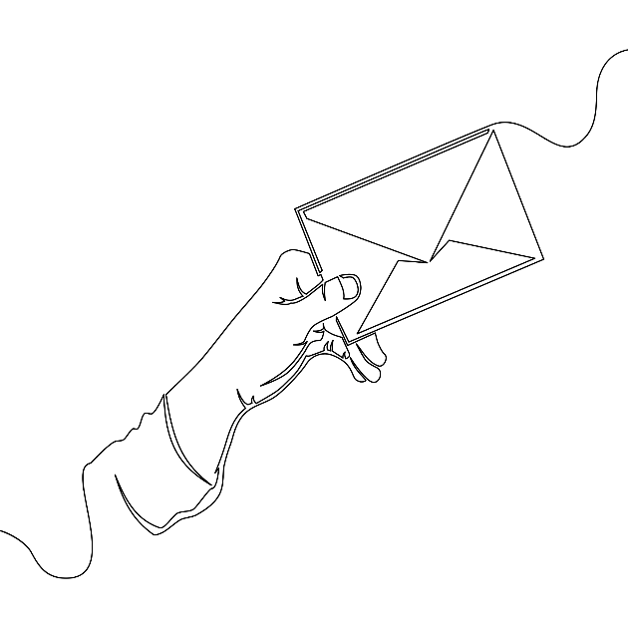
- “Future me letter method”. This task can be done both online and live. If the task is performed live, the performer undertakes to send letters to the participants after a certain period. Before completing the task, set rules for the participants:
- Indicate that they are writing a letter to themselves for the future and define a period – month, year, two years, five years.
- When writing a letter, a person must: tell them who they are now; indicate what you are aiming for now and how you plan to achieve it; set yourself future goals and wish yourself something.
You can find the letter form online: FutureMe: Write a Letter to your Future Self
- „Mosaic“ Mosaics, collages are collected and glued (pictures from magazines, interactive collages) on agreed topics, such as “What motivates me?”, “My tomorrow”, “My future profession” and the like. When collecting and visualizing his inner expressions, a person grounds desires, motives, thoughts.
- Fastening, promise to yourself.
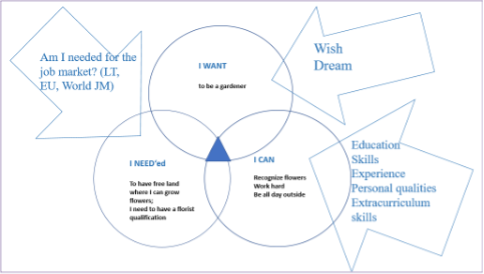
- „The bubble test: I want, I can, I need“ In the “I want” column, enter the desired job position, profession, dream. The qualities listed in the “I can” section are required for this profession: physical, mental, required education, hobbies, what subjects had to be followed in school to work in this job. There must be at least 20 positions, a smaller number indicates that the person is unfamiliar with the profession. The “Need” section assesses whether the profession is needed by the labor market (national, European, global).
Task: put in order and choose methods what will suit Your group:
Promoting motivation for activities. Self-assessment of starting point, position. |
|
The importance of taking personal responsibility for your goals. |
|
Formulation of goals, formation of a plan to achieve them. |
|
Fastening, promise to yourself. |
|
The participant reads the situations and answers the questions about how he would solve the given situations, how he would act as a career consultant. They give their answers in a general group, e.g. Padlet.

1 situation: ANDRIUS.
Andrius graduated from computer science studies in Kaunas. After his studies, he decided to stay in this city and look for a job according to his specialty. The guy tried to look for a job in various companies, but it was difficult to find a job. They asked for work experience everywhere. Andrius registered at the Employment Service, here after several unsuccessful job interviews, he completely lost confidence and the desire to participate in job interviews, he no longer expected to get a job according to his specialty, he no longer had money to live in a big city, he realized that he would have to return to his parents in a small town and take up unskilled work.
You are Andrius career consultant, you offer Andrius to attend motivational training sessions. By what means will you raise Andrius motivation, write min. 5 steps/activity.
2 situation: LINAS.
Linas dropped out of school at the age of 16. He went abroad with his mother, but he stopped going to school, got a job here and there, started earning, spent the money quickly, lived with his mother, didn’t have to worry about taxes and food. At the age of 21 went to Lithuania, registered with the Employment Service, where unskilled, poorly paid jobs were offered. Linas worked for a few weeks and was not satisfied with the salary or the working conditions, so he quit the job. After refusing several job offers, he was thrown out of the Employment Service, lost his social allowance, cannot pay for an apartment, and hides with some relatives.
You are an employee of a local youth organization, you meet Linas in a charity canteen, and you offer to come to informal activities to increase employment. Linas is coming. What steps do you take, what activities do you offer to Lin in order to raise Lin’s motivation for work, self-care, responsibility for his life. provide min. 5 steps/activity.
Example how could look answers (for.egz.Padlet or Miro):
