The main reasons for the unemployment of unmotivated young unemployed people who are not ready for the labor market are low level of education and abilities, lack of motivation and lack of self-confidence. These reasons are closely related to each other and influence a person’s helplessness and prior reluctance to change the current situation, to achieve higher goals. In order to help these individuals integrate into society and the labor market, it is important to strengthen, first of all, the motivation and self-confidence of these individuals, to encourage them to take personal responsibility for their lives. Self-confidence gives strength to take action and constantly look for new opportunities.

During the training, employees will be presented with theoretical knowledge and practical skills about the specifics of working with youth.
Cognitive abilities:
– Basic understanding of teaching methods which increase a person’s self-confidence.
– Highlighting the strengths of a young person.
Soft skills:
– To master and be able to use effective and individual methods and techniques for increasing and increasing self-confidence.
- Self-confidence – evaluation of the individual himself, his capabilities, qualities and place among other people.
- Expectation – a strong belief that something will happen or be the case.
- Purpose – the reason for which something is done or created or for which something exists.
- Mistrust – be suspicious of; have no confidence in.
- Skills – the ability to do something well; expertise.
- Soft skills – personal attributes that enable someone to interact effectively and harmoniously with other people.
- Hard skills – specific abilities, or capabilities, that an individual can possess and demonstrate in a measured way.
- Values – these are the most important principles that guide us in our lives.
- Interest – is being interested in someone with a desire to get to know them.
- Competence – the ability to perform a certain work (task) in a real or simulated situation. Competence includes knowledge, experience, skills, and often certain personal qualities. The essence of competence is the ability to practically apply knowledge and available attitudes.
- Topic 1. Self confidence (theoretical)
- Topic 2. Transfer of knowledge (methodical recommendation)
- Topic 3: Methodology frame (activities)
- Topic 4: Final assessment (interactive task).
Self-confidence is an attitude about your skills and abilities. It means you accept and trust yourself and have a sense of control in your life. You know your strengths and weakness well, and have a positive view of yourself. You set realistic expectations and goals, communicate assertively, and can handle criticism.
On the other hand, low self-confidence might make you feel full of self-doubt, be passive or submissive, or have difficulty trusting others. You may feel inferior, unloved, or be sensitive to criticism. Feeling confident in yourself might depend on the situation. For instance, you can feel very confident in some areas, such as academics, but lack confidence in others, like relationships.
Having high or low self-confidence is rarely related to your actual abilities, and mostly based on your perceptions. Perceptions are the way your think about yourself and these thoughts can be flawed.
The main thing that prevents a person from improving and changing his life is the fear of failure and lack of self-confidence. Self-confidence is an attitude that allows a person to create a positive, but at the same time realistic image of yourself and the situation. By yourself confident people believe in their abilities, feel that they can control their lives and can achieve your goals. Even if sometimes they fail, such people remain positive and value themselves positively. More often than not, they see opportunities in problems rather than problems in opportunities. Related to self-esteem is how we perceive the world: we
may find it attractive, accepting, benevolent, or vice versa – hostile, aggressive, attacking, demanding. A positive, self-confident person overcomes difficulties or even them more easily don’t notice Lowered self-esteem paints the situation in dark colors – increases it problems, makes you feel overly responsible and at the same time powerless.
- Recognize and emphasize your strengths. Reward and praise yourself for your efforts and progress.
- When you stumble on an obstacle, treat yourself with kindness and compassion. Don’t dwell on failure.
- Set realistic and achievable goals. Do not expect perfection; it is impossible to be perfect in every aspect of life.
- Slow down when you are feeling intense emotions and think logically about the situation.
- Challenge making assumptions about yourself, people and situations.
- Recognize that past negative life experiences do not dictate your future.
- Express your feelings, beliefs and needs directly and respectfully
- Learn to say no to unreasonable requests.
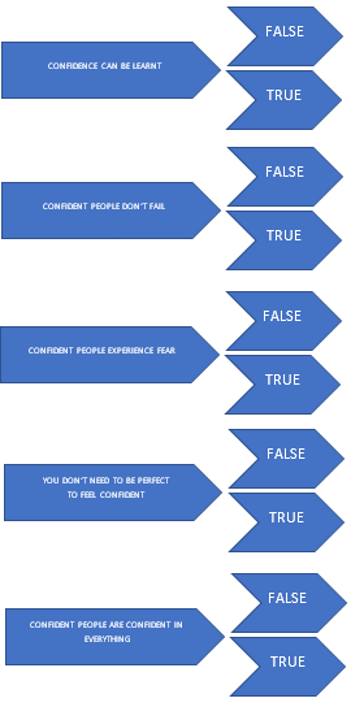
Dispelling myths: True or False?
At the beginning of the program, it is recommended to establish group behavior rules – agreements, because a large part of the success of the program depends on the participants’ openness, readiness to share their experience, identify problems, therefore mutual communication and trust are extremely important. Among the possible rules can be mentioned: confidentiality, openness, speaking one by one, the right to “Stop” and the like.
The selection of methods depends very much on the dynamics of the group and the existing conditions, therefore several methods are presented for each part, and it is suggested to choose the most appropriate one independently.
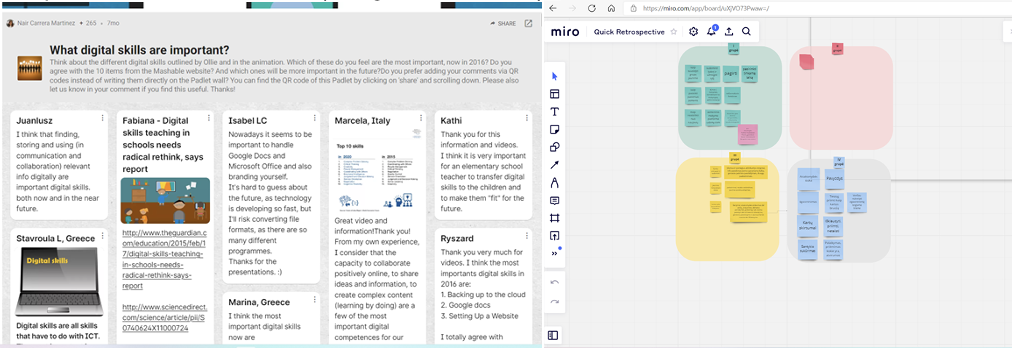
What challenges you have working with groups increasing self-confidence? – please write min 5 points.
Example how could look answers (for.egz.Padlet or Miro):
When working with a group, it is suggested to follow such a form of group activity, which goes from getting to know each other, predicting expectations, self-knowledge, self-evaluation, self-evaluation and generalization, and goal prediction.
- Getting to know each other and setting expectations:
Getting to know each other and setting expectations is a stage that is repeated several times throughout the program. First acquaintance with the project, the project participants, the coordinator is the most important among them, because it lays the foundations for the group’s activities and trust to each other, which are necessary for the success of the program.
In order to achieve closer communication and openness, there are not enough formal ways of getting to know each other, so during the course of the program, additional informal dating methods are used, some of which are presented below:
- The Name game. Participant writes his name vertically one letter by one, then he finds the strength of each letter of his name and writes it down. Discuss what characteristics people have written down and how important they are to him.

- “I don‘t want to brag / I am proud of“ method. Describe each person to tell a fact about themselves. Starting the sentence, I don‘t want to brag or O am proud of. This task will allow individuals to see how different everyone is, and that the qualities of one that others consider inappropriate and weak are indeed the pride and strength of others.
- The Coin game Give individuals different coins. In your group, discuss why you have chosen one coin or another and how the coin reflects you. Listen carefully to what your group members are saying and note what features everyone found on the coin. You have 10 minutes to do this. Now think about whether you have the same things listed by other participants. Or maybe you don’t have them, but would like to have them? Now back to the big circle. Please stand up to those who have identified with the same coin as you. Look at them to see what similarities have helped you find them coin. Look around at what gathered in the other three groups (10 min.). Stay in the new group and discuss why you combined this coin. Think about what else can unite you. You have 10 minutes.
The first group of topics that the project participants begin to examine is self-knowledge. It is like the beginning of the whole project a very relevant topic, because only by knowing and understanding ourselves can we understand the relationship with the environment, other people, and also the desire do you need to change something? The topic of self-knowledge is studied for about three weeks and lays the foundations for the study of further topics:
- Self-awareness can include the following sub-topics:
- Self-awareness is a continuous process;
- Feelings and their recognition;
- Positive self-esteem;
- Self-image;
- Values;
- Measuring;
- Changing negative thinking;
- Stress and its management;
- Hello, lifestyle and other things.
At this stage, it is important to encourage the participants to actively delve into themselves, their feelings and thoughts and their obstacles, the desire to understand and manage them.
Three main areas of self-knowledge: interests, talents, values. It is recommended to choose one method for researching each of the areas. Below are some methods that can be applied to encourage better self-awareness among participants;
- Leaf tearing method. Distribute one sheet of paper to the individuals. Let them know that you will give them instructions but will not respond to questions. They must do what you say the way they succeed. what they have to do with that sheet and ask them to stand in a circle and close their eyes.
- When individuals close their eyes, ask participants to fold the sheet in half.
- Ask to tear off the top right corner of the sheet.
- Ask the participants to fold the sheet in half again.
- Ask to tear off the top right corner of the sheet again.
- Ask the participants to fold the sheet in half again.
- Ask to tear off the top right corner of the sheet again.
- Ask the participants to fold the sheet in half again.
- Ask the top right corner of the sheet to be torn off again.
- Ask the participants to open their eyes and unfold their sheet.
- Take a look at how different the leaves are for everyone. Discuss why they are so different if everyone got the same instructions.
Discuss that being different is not a bad thing.
- Peter Gerrickens and Marijke Verstege Feedback Game. In everyday life, we are all confronted with our own distinctive features. You may notice that you are enterprising, sensitive, or scrupulous. However, you might sometimes catch yourself acting callously or feeling indifferent to other people. We all occasionally ask ourselves: what line of work would suit me best? How can I overcome the weaknesses that I don’t like? What are my hidden talents? By taking our existing strengths as a basis, we can find an answer to these questions. The strengths that we possess are an important motive that reveals why we do what we do and how we do it. The basic principle used in this guide is that people work their best and feel happy when they can optimally showcase their strengths. The more frequently a person fully reveals his or her strengths, the more useful and happier he or she feels. For most people, it is difficult to make optimal use of their strengths in everyday life. With this guide, you will be able to explore your own abundance of strengths. Each person should know their personality and explore their possibilities and limitations. This helps to better perceive and understand your own behavior and that of others. The feedback game and this guide are for everyone who is interested in qualities. This game and guide are intended for communication teachers, managers, advisers, consultants, teachers, and anyone else whose work requires strength. They are also meant for people who want to better know themselves, taking the personal qualities that they possess into account. This game and its guide are suitable for people of various academic backgrounds, and the examples that I present are also very diverse. The following developers also offer more behavior card games, link to their official website: Peter Gerrickens and Marijke Verstege – Feedback Game – Kwaliteitenspel
- SWOT analysis
Individuals draw a rectangle on the sheet, which is divided into four equal parts. Before continuing with the task, determine what you will analyse and discuss with the individuals. (For example, the opportunity to study and acquire a profession). Ask individuals to enter 3-5 aspects in each box. In the first window you should list your strengths as a person. In the second window, list your weaknesses (weaknesses). In the third window, list your options. In the fourth window your fears. 2 After completing the task, discuss, discuss what new qualities did the individuals see in themselves? How important are these qualities? Can we adjust and change properties so that they are in the next window? If so, what do you have to do about it?

- Self-knowledge through projection. It is possible to work with OH cards or creating a psychological portrait with career projection.
- Behavior card game, link to their official website: OH Cards | Home (oh-cards.com)
- An example of a projection task: “What would you be if you were?”
If you were… who would you be? | What qualities does he/she have? What does it mean to you (say about you)? What is it associated with? |
Book |
|
Tree |
|
A body of water |
|
Season |
|
Flower, plant |
|
Material (substance) |
|
Form |
|
Color |
|
Metal |
|
Heavenly body |
|
Animal |
|
A work of art |
|
Music (a piece of music) |
|
Gem (jewel) |
|
Relationship With The Environment

Communication and relationship with the environment is the second topic after self-knowledge. At this stage, participants are encouraged to analyze your communication with family, friends, other people, their reasons and consequences. This topic also includes getting to know basics of psychology, presentation of social roles, verbal and non-verbal communication, etc. The following topics are offered subtopics:
- Expression of feelings and anger management;
- Communication psychology;
- Social communication;
- Social roles;
- Verbal communication, body language;
- Family life, caring for others and more.
Below are some methods that can be applied to encourage participants:
- Auction of values.
Description: The players name the values they know and are relevant to. They are written on a sheet. Players are divided into groups that receive the same amount of money, i.e. means to achieve the values. The groups must consult and decide which values they need most. Values are sold as stock. The host bids the starting price, the group bids until, on the count of three, one of them buys the value.
Discussion: Did you buy what you wanted? Why did you choose those values?
- Peter Gerrickens and Marijke Verstege Feedback Game
In everyday life, we are all confronted with our own distinctive features. You may notice that you are enterprising, sensitive, or scrupulous. However, you might sometimes catch yourself acting callously or feeling indifferent to other people. We all occasionally ask ourselves: what line of work would suit me best? How can I overcome the weaknesses that I don’t like? What are my hidden talents? By taking our existing strengths as a basis, we can find an answer to these questions. The strengths that we possess are an important motive that reveals why we do what we do and how we do it. The basic principle used in this guide is that people work their best and feel happy when they can optimally showcase their strengths. The more frequently a person fully reveals his or her strengths, the more useful and happier he or she feels. For most people, it is difficult to make optimal use of their strengths in everyday life. With this guide, you will be able to explore your own abundance of strengths. Each person should know their personality and explore their possibilities and limitations. This helps to better perceive and understand your own behavior and that of others. The feedback game and this guide are for everyone who is interested in qualities. This game and guide are intended for communication teachers, managers, advisers, consultants, teachers, and anyone else whose work requires strength. They are also meant for people who want to better know themselves, taking the personal qualities that they possess into account. This game and its guide are suitable for people of various academic backgrounds, and the examples that I present are also very diverse.
The following developers also offer more behavior card games, link to their official website: Peter Gerrickens and Marijke Verstege – Feedback Game – Kwaliteitenspel
- Johari window
The Johari Window model is a simple and useful tool for illustrating and improving self-awareness, and mutual understanding between individuals within a group. This model can also be used to assess and improve a group’s relationship with other groups. This model is particularly useful in team development.
Key points:
Participants choose a set of adjectives they feel best describe themselves, and the rest of the group do likewise. Then, the results are compared and grouped into one of four sections, or ‘panes’.
Through a process of disclosure and feedback, openness and understanding are encouraged. This in turn will improve communication, team development and group dynamics and equality. It also helps limit conflict, confusion, and misunderstanding.
While this can be a useful exercise, it’s best to apply it with sensitivity, and avoid judgment and negativity.
| Known to Self | Not known to Self |
Know to Others |
OPEN SELF (Information about you that you and others know) |
BLIND SELF |
Not know to Others |
HIDDEN SELF |
UNKNOWN SELF (Information about you that neither you nor others know) |
- Self-confidence and employment:
Self-confidence in the employment process is one of the key reasons for success. Because at all stages of employment: in the evaluation of the suitability for the proposed job position, in the conversation with the employer, in the public presentation of oneself, in the process of communication with the team, an objective, positive self-evaluation is required. Therefore, determining one’s work competences and advantages is one of the main tasks that allows an individual to see his advantages and present them properly to the labor market.
Below are some methods that can be applied to encourage participants:
- Test “What does the employer want?” An annual employer survey asks employers what their requirements are for potential employees. The results of the study (soft and hard professional skills) are presented to individuals, and they are asked to indicate where and how they have acquired or can acquire these skills.
Examples:
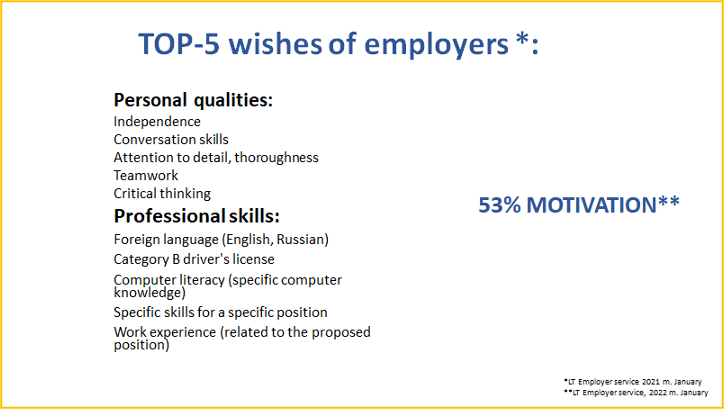
- „The bubble test: I want, I can, I need “. Test “I want, I can, I need”. In the “I want” column, enter the desired job position, profession, dream. The qualities listed in the “I can” section are required for this profession: physical, mental, required education, hobbies, what subjects had to be followed in school to work in this job. There must be at least 20 positions, a smaller number indicates that the person is unfamiliar with the profession. The “Need” section assesses whether the profession is needed by the labor market (national, European, global).
Anticipating Expectations:
The last part of the training is the identification of goals, setting. This part of the program aims to use the knowledge and skills acquired during the program to change the current situation.
- Game „Mosaic“. Mosaics, collages are collected and glued (pictures from magazines, interactive collages) on agreed topics, such as “What motivates me?”, “My tomorrow”, “My future profession” and the like. When collecting and visualizing his inner expressions, a person grounds desires, motives, thoughts.

- Future me letter method. This task can be done both online and live. If the task is performed live, the performer undertakes to send letters to the participants after a certain period.
Before completing the task, set rules for the participants.
- Indicate that they are writing a letter to themselves for the future and define a period – month, year, two years, five years.
- When writing a letter, a person must: tell them who they are now; indicate what you are aiming for now and how you plan to achieve it; set yourself future goals and wish yourself something.
You can find the letter form online: FutureMe: Write a Letter to your Future Self
Task: put in order and choose methods what will suit Your group?
Getting to know each other and setting expectations. |
|
Anticipating expectations. |
|
Self-confidence and employment. |
|
Self-knowledge. |
|
Relationship with the environment. |
|
Solving situations:

Situation number 1
The manager of company X, thirty-five years old Renata, is a successful woman… The huge company under her management achieves very good results… everything would be great, but she doesn’t feel happy in life… everything seems to be perfect at work… she is respected and loved by everyone, but her in her opinion, everyone is “playing” sincerity… she has been living “in a relationship” with her boyfriend for maybe four years… she does not feel comfortable and satisfied with him… she understands that he is not her husband, but she simply feels under his care and does not dare to cut him off these branches… her eight-year-old son from her first marriage constantly demands attention and feels guilty for not spending enough time with him. Now she is dealing with the dilemma: to prepare for the second child or not… to the question:
– And why do you have a second child, she answers:
– Jonukas (her son) really wants a brother or sister… well, but I also want…
– Is it you or the son?
– And I…
– And why do you have a child…
– He will bring me joy… I always remember my mother surrounded by children and grandchildren and enjoying them (she has a sister a year older and a brother a few years younger).
Who determines Renata’s behavior and choices?
How would it be appropriate for Renata to act?
What methods would you use to solve this situation?
Situation number 2
John came to work at company X. A good specialist who achieves excellent results, he got the impression that he was not committed to the company. John started to feel bad in the team, not understanding why others look at him askance and evaluate him in this way, although the director is satisfied with him and his work results.
John usually leaves work at exactly five o’clock, and the vast majority of the staff
working overtime.
How should John behave?
What methods would you use to solve this situation?
Situation number 3
Mindaugas, a talented young specialist, received an offer to read a report at a conference in Paris. He understands that this is a chance for new career opportunities.
On the same weekend, my mother’s anniversary birthday will take place, which was planned half a year ago (the whole family will participate in it), and my mother arranged the date with Mindaugas so that he could definitely attend. Confusion arose inside Mindaugas: “What to do?”
How should Mindaugas behave?
What methods would you use to solve this situation?
Your personal experience
Example how could look answers (for.egz.Padlet or Miro):