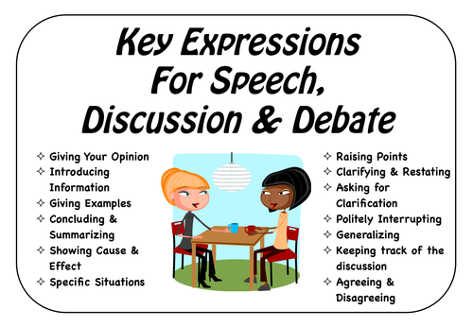
But what is social factor/ issue?
Definition of the social issue and description and categorization of the main problem categories.
A social issue is a problem that affects many people within a society. It is a group of common problems in present-day society and ones that many people strive to solve. It is often the consequence of factors extending beyond an individual’s control.
Through the courses, the students are invited to be trained based on the theories related to social problems. The lessons aim to help students externalize their deepest concerns and internal negative experiences they have experienced in the past. The lessons are intended to promote dialogue and make students embrace their problems in order to combat any doubts they may have about themselves and those around them.
This video can be the audiovisual ‘bridge’ between the introduction and the main course.
Knowledge:
– Understand the training needs of your learners who are facing social challenges . Calm communication, active listening and compromise: Educators are one of the most influential persons in young people’s life. It is important for them to learn how to lay a strong foundation before the youth’s window of such opportunity closes.
– Gain knowledge of suitable training methods addressed to learners dealing with social challenges.
Skills:
– Develop the outline of your future course contents in accordance with the needs of the learners. Trainers will achieve that by using feedback from their students. Along with individual feedback (written or verbal), teachers need to provide whole-group feedback on patterns they see in the collective class’ growth and areas of need. Students also need to be given opportunities to provide feedback to the teacher so that she can adjust the learning process, materials, and instruction accordingly. In our case, problem-solving is an important life skill for young people: Educators will familiarize themselves with and apply methods of helping young people learn to solve their problems by working together.
Attitude:
– Learn how to facilitate communication among their learners and how to create a safe and smooth environment for the students in order to express their real feelings.
What are the most common real social concerns young people face?
- Toxic family relationships
- Low educational family level
- Addictive substances
- Violence of any kind
- Financial problems, such as unemployment, low salaries or low-income families
- Peer competition-bullying
Across the EU, 14% of young adults are at risk of depression, and 4% of young people aged 15-24 suffer from chronic depression. Young women are more likely to find themselves not in employment, education or training, and are significantly more likely to suffer depressive symptoms than young men. Child and youth homelessness have increased dramatically in several Member States over the past decade, and almost three out of ten children in the EU were at risk of poverty in 2021. Despite these difficulties, Eurofound’s research shows that a significant proportion of young people in Europe struggle to access vital health and public services.
Young people today go through and are expected to cope with parental forces (especially for those coming from low educational level families or those having experienced difficult childhood moments), work and school pressures, peer-pressure and competition, and so on. Many young people feel misunderstood. It is vital that their feelings and thoughts are validated, and that the validation process comes not only from their parents but also their educators. Educators are the ones who need to approach their learners, who have been dealing with such social issues, carefully and in a friendly manner to discuss all possible concerns.
This e-learning module will focus on what educators having learners facing with cocial issues in their educational environment should rethink their educational methods and learning pathways. In such a learning environment, the teacher has a complex and multidimensional role. As a leader in an effective classroom, his primary concern is providing equal opportunities to all students. Its teaching is called upon to respond to their particular educational needs, with the result that the syllabus and textbooks are differentiated and utilized accordingly. Therefore, his adequate training emerges as vital, for the improvement of his practices and methods.
Modern educators owe it to themselves to know how to teach in mixed-ability classrooms. For the implementation of inclusive education, proper teaching planning is needed in gradual steps, so that there is a combination of individualization and the offering of a common program at the same time. And this is exactly the main knowledge, that will be gained through this module. Differentiated teaching can be the answer to problems related to increasing diversity and social factors in general. The teacher’s ability to self-criticize during the course of teaching contributes to its success, in order to receive feedback and to appropriately differentiate his strategies. In particular, the development of a larger repertoire of teaching techniques, alternative teaching and administrative methods, and diverse ways of learning is necessary. Everything is consistent with finding ways to create ideal conditions, which will facilitate and support learning for all children without exception, according to the ideology of inclusion.
Let’s attend this video related to the social issues in education:
Here are the contents:
- Organizational skills.
- Communication skills
- Improving self-confidence.
- Interpersonal skills.
- Negotiating skills.
- Collaboration skills.
- Problem-solving skills.
- Critical thinking
The success of training will be evaluated against a set of achievement indicators:
- Reflection time (through some conversations)
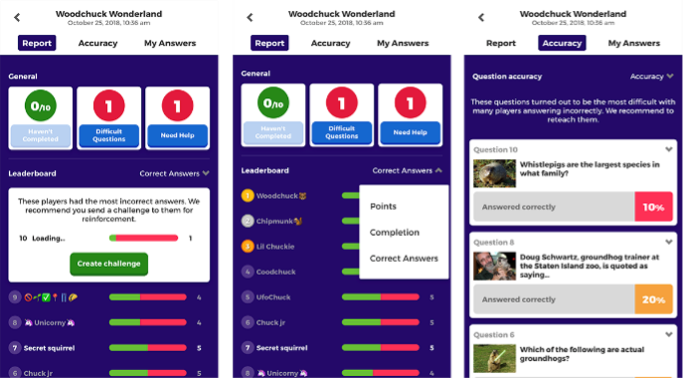
- Evaluation sheets combining evaluation games. Multiple choice quizzes – often the norm for eLearning course assessments. Perhaps not in all cases, but I’m sure that most of you reading this will acknowledge that quizzes are a widely adopted strategy when it comes to eLearning course creation. The first digital assessment tool that will be used is Kahoot and the quiz will have the following form.
Here is a “guide link”:
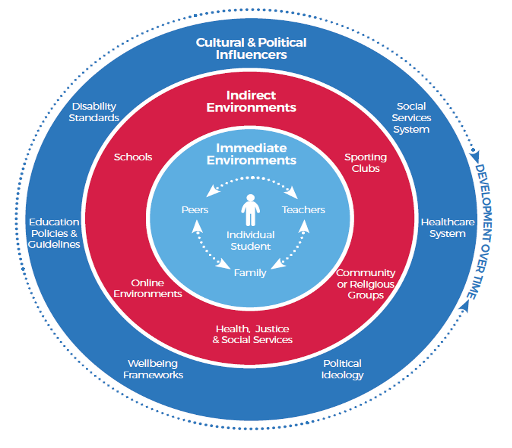
Family, peers, school and the wider community all impact on student behaviour, and on learning and wellbeing. The way we behave is also influenced by personal characteristics such as age, sex, personality, temperament and mental and physical health. The following model helps us to identify how multiple environments influence our learning, wellbeing and development, and how risk and protective factors can impact.
For example, risk factors, such as economic disadvantage can increase the probability that a problem will develop and persist. Protective factors, such as a supportive family and community can minimise the impact of risk factors. Some students develop along ‘normal’ trajectories despite the presence of significant risk factors. This capacity to achieve developmental milestones in the face of adversity is called ‘resilience’.
Social-ecological systems theory represented in the diagram below is useful to describe the factors influencing student behaviour and wellbeing.
Most of the issues in the educational system consist of some of the major problems affecting society today.
GENDER INEQUALITY:
All genders have an equal opportunity in education, but this is not the case in school. Gender inequality is a social issue that mostly affects female students. In some societies, there are few learning opportunities in learning environments for female students mainly because they are considered as inferior beings, thus limiting them to only home education.
RACISM:
Some learners can get their racist views from their parents and teachers. Racism tops the list of social issues affecting students and schools. You can get more information about this problem from free essay examples on social issues. Therefore, resolving this problem requires participation from all shareholders in the education sector including their tutors, parents at home, and education support professionals.
UNEQUAL OPPORTUNITY:
Learning in an environment that accepts students from different cultural and economic backgrounds comes with its challenges. The financial position of the parents is the reason why some students face with social issues. Some of the services in educational systems are offered based on the cultural affiliation and income level of the students. Some of the students come from immigrant families.
NEGATIVE PEER PRESSURE:
Negative peer pressure in school is the leading cause of student substance abuse and developing criminal behaviours. There are cases of student gangs in school, most of which are involved in fights and victimizing other students. The use of alcohol and illicit drugs withdraws the interest of education from the student and may eventually lead them to drop out of school.
BULLING:
Bulling is considered a social issue because it affects society, and its influence goes beyond individual control. This form of aggression is usually directed to victims of inferior features in school, workplaces, and social relationships. School or student bullying can have devastating effects. Students who have developed such aggressive behaviours should be isolated from the vulnerable.
While there’s no one-step cure to bias, prejudice, and blatant hate, social awareness is an important starting point for the immense amount of work that needs to be done. Understanding differences, appreciating diversity, being respectful with others, realizing how what you do affects others and extending a caring hand to those who get mistreated are the starting points of social justice. A fight for social justice can be built upon those skills.
Social awareness educates people to look outside of themselves and realize it takes many people to make the world go around. It teaches people to put down their biases and assumptions on how the world works or should work. It opens up their eyes to seeing many perspectives and learning how to co-exist with an endless variety of individuals.
Social- awareness is a teachable concept, and when used in the classroom students can start leaving their positive mark on their world.
Educators are the ones who should first develop empathy and social awareness. To try to get close to their students in every way, to create a safe framework and to build a solid ground on which relationships of trust can be built with the ultimate goal of the smooth integration of students into the educational process.
TRUE or FALSE
- Protective factors, such as a supportive family and community can minimise the impact of risk factors. ( )
- This capacity to achieve developmental milestones in the face of adversity is called ‘empathy’. ( )
- Gender inequality is a social issue that mostly affects male students. ( )
- Negative peer pressure in school is the less important cause of student substance abuse and developing criminal behaviours. ( )
- Social awareness educates people to look outside of themselves and realize it takes many people to make the world go around. ( )
– Brainstorming: sharing of ideas without evaluation or judgement. Brainstorming is a method design teams use to generate ideas to solve clearly defined design problems. In controlled conditions and a free-thinking environment, teams approach a problem by such means as “How Might We” questions. They produce a vast array of ideas and draw links between them to find potential solutions.
– Interactive Talks: encouraging educators to be active and analytical in their learning social-based approach. An interactive lecture is an easy way for instructors to intellectually engage and involve students as active participants in a lecture-based class of any size. Interactive lectures are classes in which the instructor breaks the lecture at least once per class to have students participate in an activity that lets them work directly with the material.
The instructor might begin the interactive segment with an engagement trigger that captures and maintains student attention.
Then the instructor incorporates an activity that allows students to apply what they have learned or give them a context for upcoming lecture material.
As the instructor feels more comfortable using interactive techniques he or she might begin to call upon a blend of various interactive techniques all in one class period.
– Group Discussions: the educator takes on the role of a group promoter, group adviser, group facilitator and group mentor. A group discussion tests the teamwork and communication skills of candidates. A group discussion involves a discussion on a given topic with other candidates, usually with similar experience and educational qualifications. Performing well in a group discussion helps you to get noticed and practicing for one improves your public speaking skills. In this article, we will review what a group discussion is, its importance in the selection process, the skills evaluated during a group discussion and how to perform well in this round.
– Panel Discussions: coordinating and moderating the discussion on social challenges, while the educators are the panellists and act as catalyst agents of the learning process.
– Role Playing Exercises: educators put into action the skills learned throughout the training. Role Playing is a technique used to develop clearer insights into stakeholder positions and the forces that facilitate or hinder positive interactions or relations. Selected group members assume assigned roles (e.g., lawyer, doctor, engineer, diplomat, etc.) and act out an instructor-created scenario (e.g., a town-hall meeting on the ethics of stem cell research). The whole group then analyzes the roles and characteristics of the various players.
– Debate Discussion: Debate Discussion is a technique appropriate for discussing a controversial issue. The class is divided into two sides of pro/con or either/or, and each side and each speaker has a limited amount of time to speak. The object of the activity is to construct reasoned arguments that address the material and consider the arguments of the other side. Beware not to allow students to discredit fellow class members with ad hominem attacks.
MATCHY- MATCHY: You have to match the each sentence bellows with one of the methods you have learnt.
- This is a method design teams use to generate ideas to solve clearly defined design problems.
- This method is an interactive lecture is an easy way for instructors to intellectually engage and involve students as active participants in a lecture-based class of any size.
- This method involves a discussion on a given topic with other candidates, usually with similar experience and educational qualifications.
- This is a technique used to develop clearer insights into stakeholder positions and the forces that facilitate or hinder positive interactions or relations.
- Coordinating and moderating the discussion on social challenges, while the educators are the panelists and act as catalyst agents of the learning process.
- This is a technique appropriate for discussing a controversial issue.
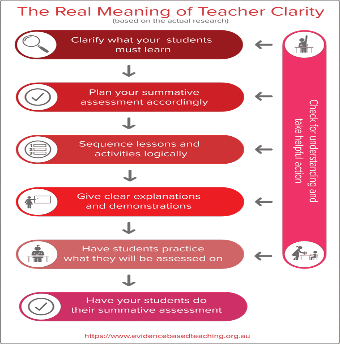
- Teacher Clarity
When a teacher begins a new unit of study or project with students, he clarifies the purpose and learning goals, and provides explicit criteria on how students can be successful.
- Classroom Discussion
Teachers need to frequently step offstage and facilitate entire class discussion. Implementing classroom discussions during a class has many benefits. The advantages include:
- Increases students’ interests and engagement – lectures mixed with discussions can help maintain students’ focus. As they discuss their answers, they get different perspectives on the topic. Good questions and answers can get students to think deeply and make connections.
- Provides Instructor with Feedback – as students answer questions, instructors can gauge whether the students understand the materials. If a student answers the question incorrectly, instructors can then help students correct their answers.
- Promotes Preparation – if the instructor regularly engages students in a classroom discussion, then students are more likely to come in prepared in class such as asking questions about assigned readings.
- Develops Students’ Speaking Skills – in many professional settings, speaking in a group is essential. Instructors prepare students to speak confidently in front of their peers. Public speaking is a skill that improves with more practice. So when an instructor promotes classroom discussions, they are preparing their students for real-world settings.
- Controls The Classroom Environment – if a student is not paying attention in class, the instructor can call upon them so he/she can focus in class better. As a result, students are more attentive to what’s happening during the lecture and discussion time.
- Formative Assessments
In order to provide students with effective and accurate feedback, teachers need to assess frequently and routinely where students are in relation to the unit of study’s learning goals or end product (summative assessment).
- It evaluates the learning process and the learner’s progress at the same time.
- A formative assessment is collaborative as it measures the student’s progress and the effectiveness of the teaching method.
- Formative assessments are interwoven with the ongoing teaching and learning process.
- It is a fluid method of evaluation. The student’s progress is not measured against a standard or benchmark unlike what you will find with summative assessment methods.
- Formative assessment requires the instructors and the students to become intentional learners.
- The aim of formative assessment is to gather actionable feedback that improves the overall teaching and learning process.
- It is a diagnostic method of evaluation.
- Results from formative assessments are immediately made available.
- Formative assessments are non-graded.
- Metacognitive Strategies
Students are given opportunities to plan and organize, monitor their own work, direct their own learning, and to self-reflect along the way. When we provide students with time and space to be aware of their own knowledge and their own thinking, student ownership increases.
5.Collaborating with colleagues
Great teachers are earnest learners. Spend some time with a colleague, or two or three, and talk about what each of these research-based, best classroom practices looks like in the classroom. Discuss each one in the context of your unique learning environment: who your students are, what they need, what they already know, etc.
Fill in the blanks in the following sentences with the appropriate words.
- With the beginning of a new unit of study or project with students, the educator has to ________ the purpose and learning goals.
- Good questions and _________ can get students to think deeply and make connections.
- Formative assessment is a diagnostic method of
- Through ______ strategies, students are given opportunities to plan and organize, monitor their own work.
- Spend some time with a ______ and talk about what each of these research-based, best classroom practices looks like in the classroom.
Let’s imagine you are part of an open discussion forum. You need to find a partner of your choice and start a debate discussion on the social challenges that a contemporary student faces and how the respective instructor can help him with these difficulties. The discussion needs to include the above topics. You have to discuss about social factors that threaten the educational progress in general. You have to suggest the most appropriate strategies and methods that a trainer should follow to gain students’ trust in order to lead them in the right pathway(bot educational and social).
Τhis is the best way to evaluate yourself in practice. Communication is always the hidden gem of assessment!